
abbey beers
From The Oxford Companion to Beer
are beers produced in the styles made famous by Belgian Trappist monks, but not actually brewed within the walls of a monastery. Today, the terms “Trappist,” “Trappistes,” and “Trappisten” or any similar derivation comprise an “appellation (controlee),” an indicator of origin. See trappist breweries. As of
Monastic life in northern France came to an abrupt halt in
On 28 February Clockwise from top left: American beer label, c. 1890; Brazilian beer label, c. 1900; Scottish beer label, c. 1940; American beer label, c. 1933; Swiss illuminated manuscript, 17th century; German colored lithograph, c. 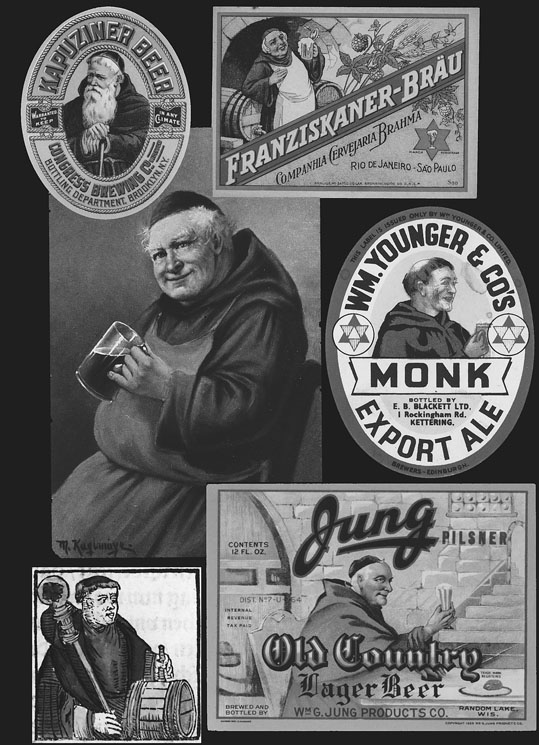
Undeterred, secular breweries have continued to name their beers “St Something” and use images of monks on labels, but provenance is now clear to those paying attention. Abbey beers are produced by everyone from tiny brewpubs to the world’s largest brewing company, AB InBev. See leffe brewery. Although the Trappist beers have exerted a clear influence on brewers worldwide, the term “Trappist” does not describe a single style and neither does the term “abbey.” The term is specific enough to be vaguely useful, but broad enough to be frustrating. Some of these beers are pale, and some are dark; some are sweet, but most are dry. Some are at least partly bottle conditioned, but others are filtered. Abbey ales do, however, tend to have a few attributes in common. They are all top-fermented ales and often employ very warm fermentations, with temperatures ranging up to 86°F (30°C). Warm fermentations combine with Belgian yeast strains to produce a range of fruity and spicy flavors. Many of the beers are strong, with most ranging from 6% alcohol by volume (ABV) to 9.5% ABV, although there are outliers at either end of that range. Darker beers tend to attain color through the use of dark candi sugar as opposed to roasted malts, and other sugars are widely used. A few are spiced, but most are not.
Under the abbey ale umbrella there are some clear styles. Tripel (triple) is a strong golden ale style pioneered by Westmalle. See tripel. Tripels have burnished, deep gold color and ABVs from 7% to 10%, with most settling in around 9%. The best examples are low in residual sugar, but may show a sweet-tasting malty fruitiness on the palate. Hop aroma is subdued and well integrated, and most have light snappy bitterness and vigorous carbonation. Despite their strength, good tripels are subtle, and they pair well with a wide range of foods. Dozens of tripels are produced in Belgium, but craft brewers in the United States and the rest of the world now brew many dozens more, some of them excellent.
The dubbel (or double) style, although somewhat less popular in the United States, is still widely produced in Belgium. These beers are dark ales, usually russet brown, with ABVs ranging from 6% to 7.5%. These are also usually technically dry, but most show a gentle caramel sweetness on the palate. The highly caramelized candi sugar syrup that produces the color also gives these beers an almost raisin-like fruitiness. Bitterness tends to be gentle. These can be great food beers, using their caramel character to harmonize with dishes featuring seared, roasted, or fried flavors.
From here, designations become less steady. A style sometimes referred to simply as “Belgian strong dark ale” or “abbey ale” intensifies the character of the classic dubbel, bringing more alcohol and fruit character at ABVs of 8% to 9.5%. When well brewed, these can make fine matches to lamb and game meats. Above this range, all bets are off, and waggish craft brewers, rarely Belgian, produce “quadrupels” at ABVs up to 14%. Although the names “dubbel” and “tripel” are of obscure origin, it is generally understood that a rising number always corresponded to rising strength. Just as some producers of California zinfandel can’t resist the allure of 16% blockbusters, so some craft brewers are attracted to similar strengths. And like California trophy wines, some quadrupels can show a wonderful plummy, figgy fruit quality, but many are merely hot. The Belgian brewer will often mutter under his breath that these beers are distinctly un-Belgian, but the American, Brazilian, or Danish beer enthusiast who loves “quads” is entirely unconcerned.
At the lighter end, distinctly Belgian but rarely seen, there is the “abbey single” or table beer. These are interpretations of the beers that Trappist monks make for themselves, which tend to be very light in both body and alcohol, rarely reaching even 5%. Although the actual Trappist versions never see the marketplace, secular brewers, having tasted the beers on monastery visits, are sometimes moved to try their hand at the gentlest of the abbey styles.
See also singel.
Trappist Beers and Monks. www.trappistbeer.net (accessed November 30, 2010).
This definition is from The Oxford Companion to Beer, edited by Garrett Oliver. © Oxford University Press 2012.